Medication tracking
Longetic is a B2C HealthTech app on the App Store. Its medications feature tracks prescribed medications and supplements, and reminds the user to take them.
I worked on the user flow and the UI, seeing design through to development. Everything shown here shipped, except where noted.
What it does
- Adds a medication in five steps: name, form, strength, schedule, and confirmation.
- Suggests names, forms, and strengths from Longetic’s own database, in the language the user types.
- Sends reminders to take each medication.
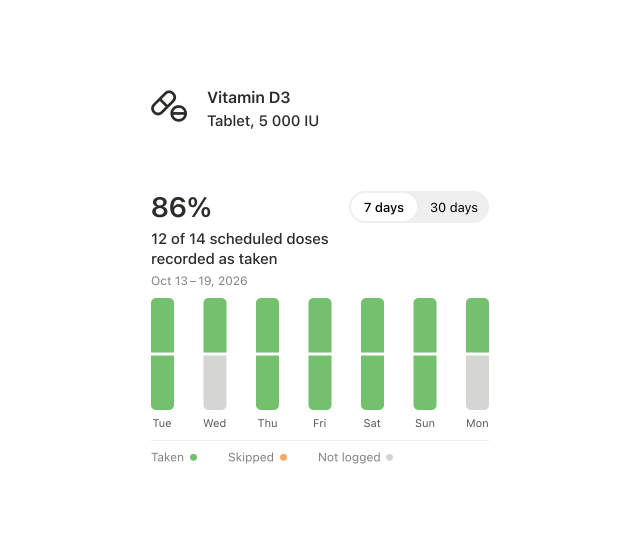
- Shows a consistency rate for each medication.
What it does not do
- Does not check interactions or suggest doses.
- Does not reset a streak or mark a skipped dose in red.
- Does not ask for a condition or a reason for taking a medication.
Product decisions
The user only types the schedule
A medication form usually asks the user to type everything: name, form, strength, and schedule. Here, name, form, and strength come as suggestions, and only the schedule needs input.
Suggestions come from Longetic’s own database of medications and supplements, with their common forms and strengths. It covers medications from anywhere in the world, in the language the user types.
A name that is not in the database can be added as typed. Form and strength can be skipped, for a user who only needs reminders and does not need the specifics of the medication.
Scheduling fits on one screen
Scheduling was first designed as two screens, with a wider range of options, including clinical schedules and doses every few days. These options were cut, and the two screens were merged into one.
Most users track supplements, and managing a condition is not their main need. So scheduling is limited to daily, specific days of the week, and as needed.
A skipped dose is grey, not red
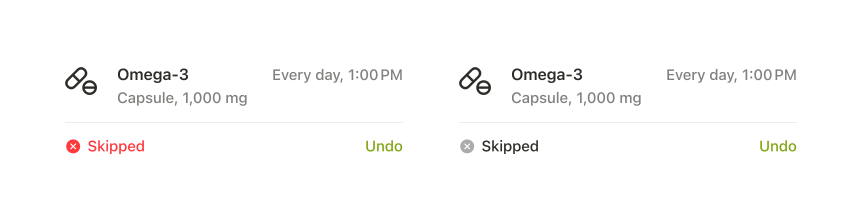
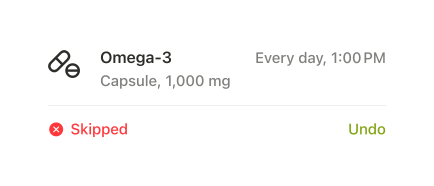
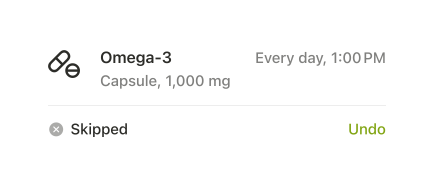
A skipped dose is marked with a cross in neutral grey, and can be undone. A red cross was rejected: it reads as a failure for one skipped dose, and a habit that feels like failing is easier to drop.
Consistency is counted per medication, not as one score
Each medication has its own consistency rate. One overall score was rejected, because medications are not equally important: skipping omega-3 is not the same as skipping a prescribed medication. A single score would let a missed supplement drag down the rate of a prescribed one.
Status
Shipped in autumn 2026. Adding a medication from a photo of the packaging or a doctor’s note is planned. Doctor’s notes already come into the app through upload, as shown in Biomarker monitoring.